
New CLAD 3D Printer Opens New Possibilities for Advanced Materials Printing
The Laboratory of Robotics at the Faculty of Electrical Engineering, University of Ljubljana, has strengthened its research infrastructure with a new ioTech io300 3D materials printer, based on innovative Continuous Laser-Assisted Deposition (CLAD) technology.
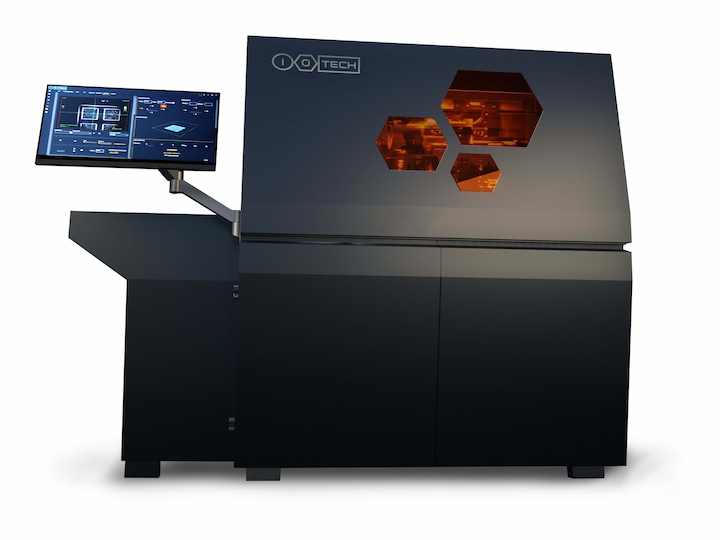
Photo: University of Ljubljana, Faculty of Electrical Engineering
Unlike conventional printing methods, CLAD is a contactless, nozzle-free process. Material is applied as a thin layer onto a transparent carrier foil, while precisely controlled laser pulses transfer microscopic droplets onto the substrate, creating complex patterns layer by layer.
The key advantage is its exceptional material versatility. The system can process highly viscous and particle-loaded pastes without reformulation, while achieving high resolution and accurate material placement. It enables printing of conductive tracks, solder pastes, metals, polymers, ceramics, silicones, adhesives and structural materials, making it highly attractive for printed electronics, sensors, microsystems and functional 3D structures.
The investment was financially supported by ARRS, the University of Ljubljana, the Jožef Stefan Institute, and industrial partners L-Tek and Dewesoft.
Source: UL FE, Roman Kamnik